Agentic AI is not a smarter chatbot. It plans. It delegates. It executes — sometimes across dozens of tool calls, API connections, and sub-agents — before a human ever sees the output.
The governance frameworks we rely on today were built for a different moment. NIST AI RMF provides a robust structure for identifying, measuring, and managing AI risk. The EU AI Act establishes lifecycle obligations — from risk classification through post-market monitoring. ISO 42001 gives organisations a management system for responsible AI. These are the right foundations, and they remain essential.
But foundations are not the same as an operational playbook.
None of these frameworks yet tells a governance team how to handle an agent that autonomously spawns sub-agents, makes irreversible decisions across tool chains, or delegates tasks to third-party APIs — all without a human in the loop. NIST's AI Agent Standards Initiative launched in early 2026, and NIST AI 100-5 addresses agentic systems specifically, but enterprise implementation guidance is still developing.
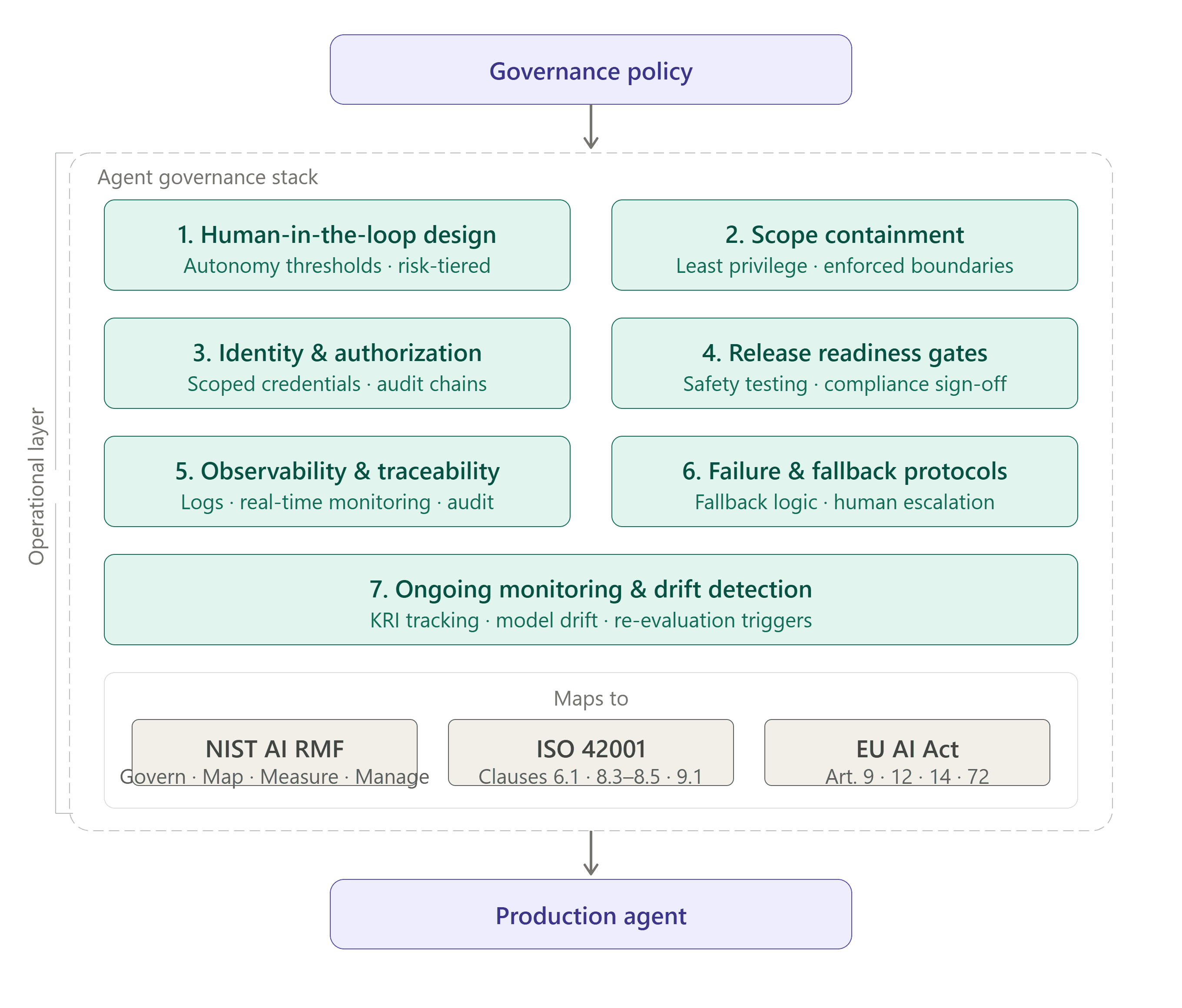
That is the gap the Agent Governance Stack addresses — a 7-pillar operational framework built to sit between your governance policy and your production agent, and to complement existing standards rather than replace them.
The 7 Pillars
The pillars follow the AI lifecycle: design decisions first, a pre-production gate in the middle, runtime governance next, and sustained oversight last.
1. Human-in-the-Loop Design
Before anything else is defined, governance requires a deliberate decision about autonomy. Where must humans approve before the agent acts? Where may they override? Where is the agent permitted to proceed without confirmation? These thresholds need to be documented, risk-tiered, and revisited as the system evolves — not assumed and forgotten.
2. Scope Containment
Once autonomy thresholds are set, the next question is: what can the agent touch? Agents that can recursively spawn sub-agents, browse the web, write to databases, and send emails on your behalf have an attack surface and an error surface that compound with each step. Scope containment means defining — and technically enforcing — the boundaries of what an agent is allowed to access. This is the agentic equivalent of the principle of least privilege.
3. Identity & Authorization
With scope defined, you can now specify who the agent is and what it is formally permitted to do. Agentic systems need clearly defined identity boundaries — scoped credentials, role-based access, and authorization chains that are auditable. Without this, you cannot answer the most basic accountability question when something goes wrong: who authorised this action?
4. Release Readiness Gates
Before any agentic system goes to production, it should pass through a structured release readiness evaluation: safety testing, red-teaming for agentic-specific failure modes, compliance mapping to applicable frameworks, and sign-off from governance stakeholders. This is the pillar most frequently skipped in the rush to deploy — and the one with the most immediate, measurable risk consequences.
5. Observability & Traceability
Once in production, you cannot govern what you cannot see. Every agent action — every tool call, every decision branch, every sub-agent delegation — must be logged in a way that supports both real-time monitoring and post-hoc audit. This is not optional for regulated environments; it is the minimum bar.
6. Failure & Fallback Protocols
What happens when the agent hits an unexpected state? When a tool call fails? When confidence drops below threshold? Agentic systems need explicit failure handling — not graceful degradation inherited from the underlying model, but governance-designed fallback logic that brings humans back into the loop at the right moment.
7. Ongoing Monitoring & Drift Detection
Deployment is not the end of governance — it is the beginning of a new phase. Agentic systems drift: models update, tool APIs change, user behaviour evolves. Ongoing monitoring means tracking KRIs (Key Risk Indicators) specific to agent behaviour, not just system uptime, and triggering re-evaluation when thresholds are breached.
How It Maps to Existing Frameworks
The Agent Governance Stack doesn't replace NIST, ISO 42001, or the EU AI Act. It operationalises them for agentic contexts:
| Stack Pillar | NIST AI RMF | ISO 42001 | EU AI Act |
|---|---|---|---|
| 1. Human-in-the-Loop Design | Manage | 8.4 | Art. 14 |
| 2. Scope Containment | Map | 6.1 | Art. 9 |
| 3. Identity & Authorization | Govern | 6.1 | Art. 9 |
| 4. Release Readiness Gates | Map + Measure | 8.3 | Art. 9 |
| 5. Observability & Traceability | Measure | 9.1 | Art. 12 |
| 6. Failure & Fallback Protocols | Manage | 8.5 | Art. 9 |
| 7. Ongoing Monitoring & Drift Detection | Measure | 9.1 | Art. 72 |
Why This Matters Now
Organisations are deploying agentic AI faster than their governance teams can track. NIST's AI Agent Standards Initiative launched in early 2026 and dedicated agentic guidance is now available — but operationalising it for enterprise teams remains an open challenge. The EU AI Act's treatment of autonomous agents will be tested in implementation as enforcement begins from August 2026.
In the meantime, governance teams need something they can use today. The Agent Governance Stack is designed to be that bridge: rigorous enough to satisfy auditors, operational enough to be used by the teams actually shipping agents.
If you're building or governing agentic AI systems, the hardest implementation challenges are worth discussing. The stack is a living framework — it evolves with the technology and with the practitioners applying it.